

Seasons Greetings
Activities for all over the Christmas holidays
Some ideas for nature-themed things to do in or near the villages or at home during the Christmas holidays from the HIGS team. If you have other suggestions for activities we would like to hear from you. Please email us at hello@higreenspaces.org.
Outdoors
Favourite ‘special’ Tree Survey
Do you have a favourite ‘special’ tree locally?
What do we mean by a ‘special’ tree? We mean any tree that is ‘special for you’.
We are all drawn to trees, but some trees come to have a special significance for us personally. This may be a single specimen, but it might be a line or avenue of trees forming a special feature. It might be on either public or private land, or it might be in your own garden.
It is good sometimes to reflect on why we consider something like a tree as special for us:
It could be its presence in the view (like the famous Sycamore Gap tree on Hadrian’s Wall), its height and spread, its particular shape, leaf or bark colour, something about its fruits, nuts or seeds.
Or it could feature in family stories or personal memories (the tree dad fell out of and broke his leg), have been planted in celebration or in memory, and so on.
Some trees in the village public realm have the distinction of having a circular bench seat around them – that tells us that these were considered special by the community at the time of their planting– the Queen’s Silver Jubilee oak on School Hill is an example. At Long Meadow HIGS has planted an oak sapling that originated in the Croft Close Nature Reserve linking our two sites, a plaque records the planting in January 2023 to celebrate the successful completion of the Abbey Fields campaign.
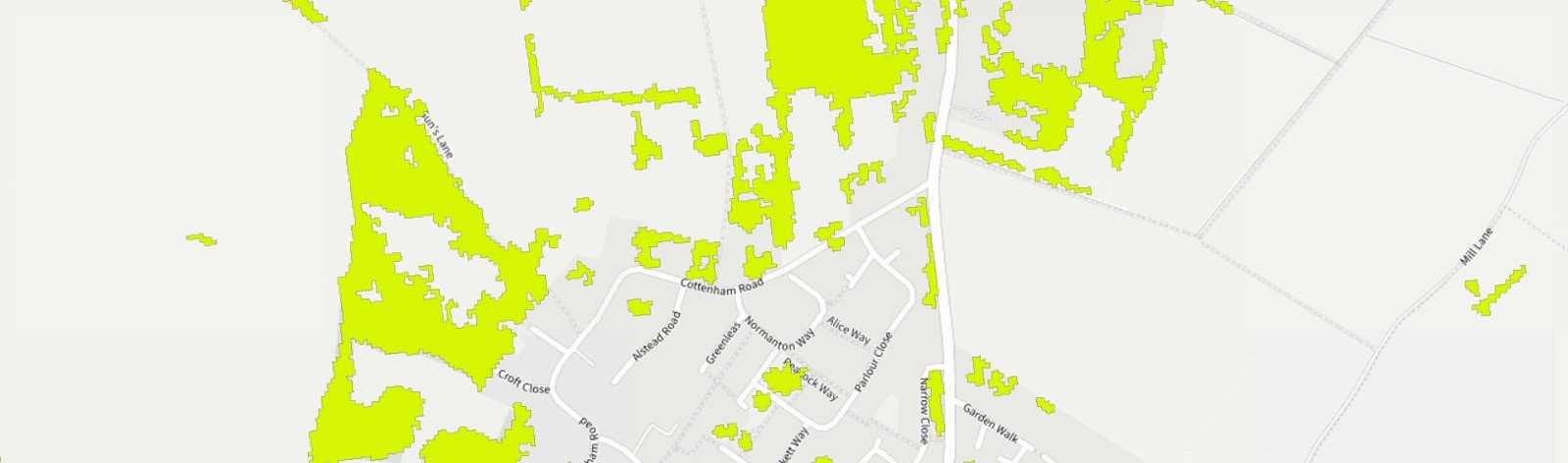
We want to put your special tree(s) on a new village map!
Enter your tree information using the button below ; you can also upload a photograph of your tree if you would like to.
Hedgehog vs Badger what do you know?
HIGS is collaborating with Histon & Impington Hedgehog Champions to try to understand the population of hedgehogs that currently live in the villages. HI Hedgehog Champions have been mapping our village hedgehogs for the last couple of years, so your hedgehog sightings may already have been recorded but transferring data to our new GIS village map will give more opportunity to analyse and to make more use of your valuable data.
And it really is valuable! Hedgehogs face a lot of threats, largely due to a loss of suitable habitat. This loss in the wider countryside is one reason why more are now being seen in gardens but pressures on habitat are also affecting badgers. Badgers can kill hedgehogs and it appears that they too are turning up in our gardens. In the wider countryside both species generally have sufficient space to avoid each other but not so in our gardens. When summer drought seriously depletes the badger’s preferred food (up to 80% earthworms), they are forced to find new sources of food and hedgehogs become vulnerable to attack.

Cambridge Natural History Society's big survey in Cambridge showed that the city was divided: some gardens in the east of the city reported hedgehogs but gardens in the west had occasional badger sightings and no reports of hedgehogs. We would like to know if we have a similar situation here in Histon and Impington and so, together with HI Hedgehog Champions, we are asking you to help us in a big push to collect as much data as we can.
HI Hedgehog Champions also promote hedgehog highways and can provide help, if you need it, to make a hole in your fence. As well as allowing hedgehogs access to the large area they need to roam every night in order to find all the food they need, and of course a mate, these highways could help hedgehogs to move away if they sense a badger is nearby. The HIGS survey will therefore also try to map hedgehog highway friendly features.
Please add your hedgehog information to our online form and we will share it with HI Hedgehog Champions. During next spring and summer, the Hedgehog Champions group will continue to collect hedgehog (and badger) sightings and we’ll be working together on building up knowledge of the population in our village.
So please keep helping the local hedgehogs and badgers by making sure your garden is safe and accessible for hedgehogs and by providing great habitats for the earthworms, beetles and other grubs that both these mammals love to eat.
Enter your hedgehog and/or badger information below using the buttons below; you can also upload a photograph as evidence if you would like to. If you would be interested in getting involved in a subsequent stage of this survey please email hello@higreenspaces.org with the subject 'Helping with hedgehog and badger surveys'.
Go and explore the ‘WI Wood’
The wood is located beside the Guided Busway close to the Community Orchard, accessible from the busway, from St Audrey’s Close or via footpaths from Somerset Road or Saffron Road. If you look on a published map you may find the name Histon Wood but it is known in the village as the ‘WI Wood’ as it was planted to celebrate the 75th anniversary of the Cambridgeshire Women’s Institute in 1993.
There are two information display boards. The information on the board beside the Histon to Girton footpath gives a detailed history of the railway at Histon – so it relates to the making of the busway along the old railway line. The other board in the middle of the wood is more about nature and what can be seen at the site.
The wood was planted with a selected range of deciduous and a few evergreen trees including: oak, field maple, sycamore, wild cherry, crab apple, hawthorn, blackthorn, dogwood, yew, scots pine, and holly. Now 30 years on it is starting to feel like a mature wood. See how many of these trees you can identify – it is not so easy in the winter! If you need help with identifying some trees take a look at the Woodland Trust guidance.
One tree that you may spot is the evergreen or holm oak. This was not part of the original planting and is considered an invasive threat to the wood – learn more about this problem here. For the past two winters HIGS has been helped by volunteers to remove holm oak saplings from the wood. We have removed a staggering 2500 saplings and there are still parts of the wood that we have not covered yet! You could help with this task at two work parties in January – it’s fun for all ages and keeping on top of the problem will really help the WI Wood thrive.
Go to RSPB Fen Drayton Lakes
How about going to this fascinating nature reserve by public transport or bike (and save yourself a parking charge). The Cambridge Busway passes right through the centre of the reserve and there is a request bus stop. And of course, it is a traffic free route for cycling all the way.
Get all the details about the reserve and what you can expect to see here.
In summer this is a really good place to see dragonflies and damselflies.
In the winter months this is a top spot to watch ducks all in their breeding season plumage and already starting to pair up.
Explore the Zoology Museum, Cambridge
The Zoology Museum is one of Cambridge's major attractions, displaying thousands of specimens spanning the entire animal kingdom, from elephants, giant ground sloths and giraffes, to birds, reptiles, insects and molluscs. Entry is free.
See the mighty 21m long Fin Whale skeleton over your head at the entrance or maybe search out Charles Darwin’s beetle collection. There is something for everyone, even a café and shop – so just go and explore!
The Museum runs a variety of free events so their Events page is always worth checking to see what is on offer.
Don’t forget to check the Museum opening hours when planning your visit. The Museum will close over Christmas and New Year from 4.30pm on Sunday 21 December 2025 and re-open at 10am on Saturday 3 January 2026.
Play Top Trumps Hedges and Trees
Fun facts about native trees and hedge plants. Our game is based on information prepared by The Tree Council.
We have 24 cards representing different trees and hedge species. Each card tells you three stats about this species; the categories are:
Maximum height – how tall can this species grow in metres
Biodiversity boost – how valuable is this species to wildlife
Maximum age – how long might this species live?
To play you will need to download the set of cards and cut them out. The full set is downloadable as a PDF document here. The cards are laid out 12 to a page as Sheet 1 and Sheet 2. Each sheet has a front (a) and a back (b) page. If possible you should print the PDF double sided. If printing single-sided you can save paper by printing only pages 2 and 4 - this will give you all the information essential to play the game.
How to play
Mix the cards up (with care if you have thin paper ‘cards’) and deal them out so each player has the same number of cards.
Each player picks up their pile of cards and looks at their TOP card only.
To start the player to the right of the dealer looks at their top card and picks the best stat on that card and tells everyone.
The other players check their TOP card for that category to see if they can beat the stat for that category.
The player with the highest stat wins that round and collects all the top cards played in that round.
They then look at their next TOP card and choose their best stat and tell everyone and the process repeats for more rounds until one player has all the cards.
Tied score: Two players might have stats that are equal—in this case, everyone stacks their TOP cards face up in the centre of the playing area. At this point, start a new round, with the last winning player sharing their highest stat with the other players. The new winner from this round will add the losing cards to their own hand, as well as the cards from the centre of the play area.
Try your hand at writing acrostic poems
An acrostic poem is a style of poetry where the first letters of every line of the poem make up a set word or words. If the set word is ‘NATURE’ the first line must start with an ‘N’, the second line with an ‘A’, the third with a ‘T’ and so on.
This is the only rule. The poem can be rhyming or blank verse – it’s up to you!
Now it’s winter;
air is cold;
trees are bare;
unending wind;
risk of snow;
earth endures.
You could write your own, or write with friends and family - one line each.
Have a go. Here are a couple of set words for you to try: ‘ABBEY FIELDS’ and ‘LONG MEADOW’.
Pictures to colour
Download three pictures to colour in here.
Word search puzzles
Try our two word search puzzles. Download the PDF here.
Local Green Spaces Quiz
It’s not just about Croft Close Nature Reserve and Long Meadow. There are a number of green spaces open to the community here in Histon and Impington – let’s see how much you know about them! Download our quiz here.